-
Investigation of electrostatic effects between charged particles and nanostructured surfaces

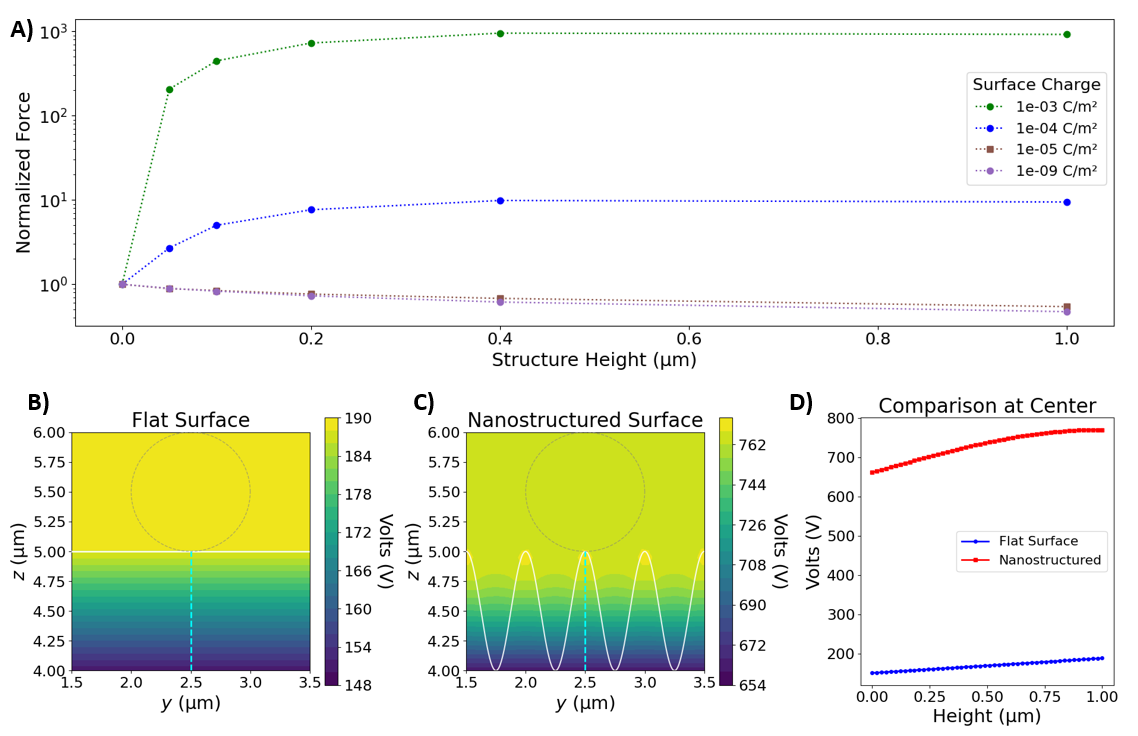
https://doi.org/10.1116/6.0004977 Abstract In this work, the effect of nanostructures and surface coatings on the effective electrostatic force acting on a particle resting on the surface is investigated. A proposed analytical model based on Coulomb’s law predicts that electrostatic forces on a particle decrease with the addition of nanostructures due to increased separation distance. Additional comsol simulations were…
-
Identification of dust particles on a periodic nanostructured substrate using scanning electron microscope imaging

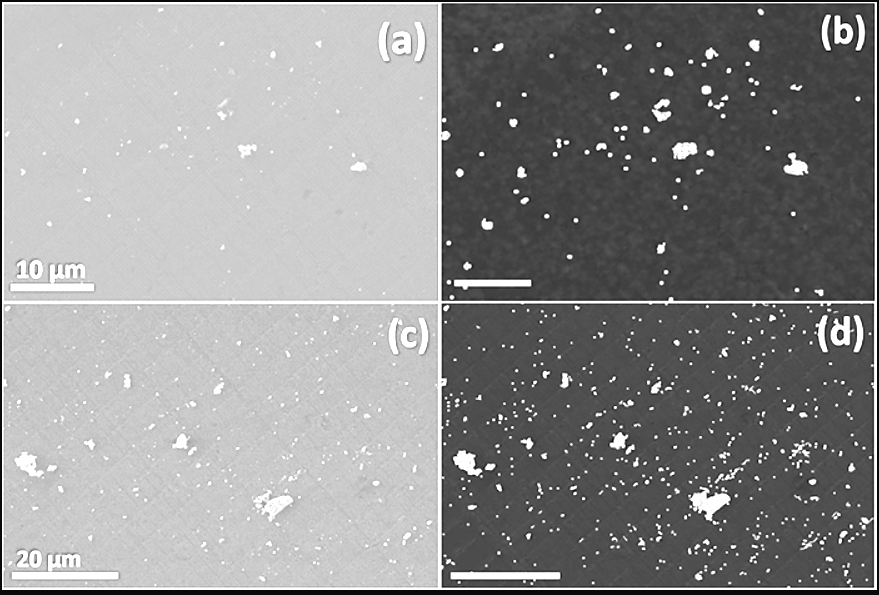
https://doi.org/10.1116/6.0003043 Abstract Dust-mitigating surfaces typically consist of high-aspect-ratio structures that separate particles from resting on the bulk material, thereby limiting adhesion due to short-range van der Waals forces. These surfaces can find uses in solar-panel coatings and a variety of dust-resistant optics. The current method for quantifying surface contamination is optical microscopy, but this method…
-
Nanoparticle dispersion and separation in superhydrophilic nanostructures

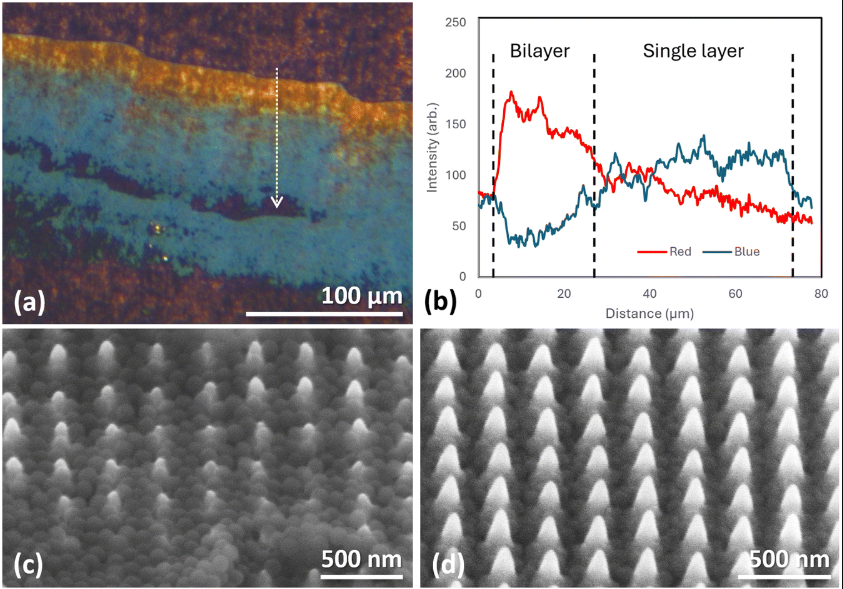
https://doi.org/10.1039/D5LF00089K Abstract Nanostructures can have novel properties that are rarely found in macroscale materials and have been employed for a wide range of applications. The wetting properties of nanostructured surfaces are particularly interesting and are controllable by engineering structure geometry and surface chemistry to create hydrophobic or hydrophilic nanostructures. In this work, we investigate the…
-
Scratch-resistant sapphire nanostructures with anti-glare, anti-fogging, and anti-dust properties

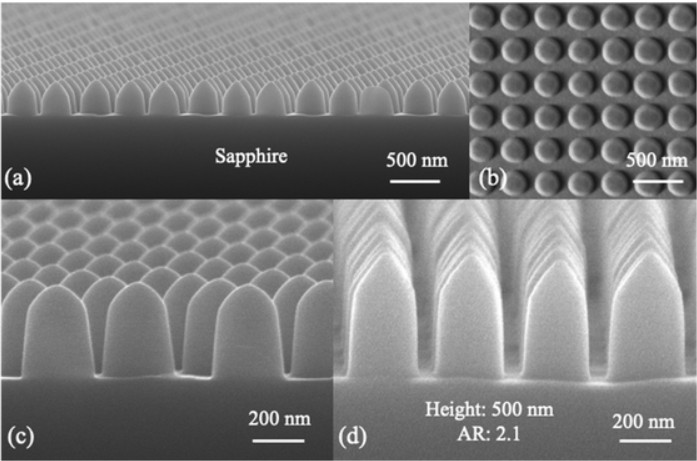
https://doi.org/10.1039/D4MH01844C Abstract Although there has been significant interest in the novel material properties of bio-inspired nanostructures, engineering them to become mechanically durable remains a significant challenge. This work demonstrates the fabrication of sapphire nanostructures with anti-glare, anti-fogging, anti-dust and scratch-resistant properties. The fabricated nanostructures demonstrated a period of 330 nm and an aspect ratio of…
-
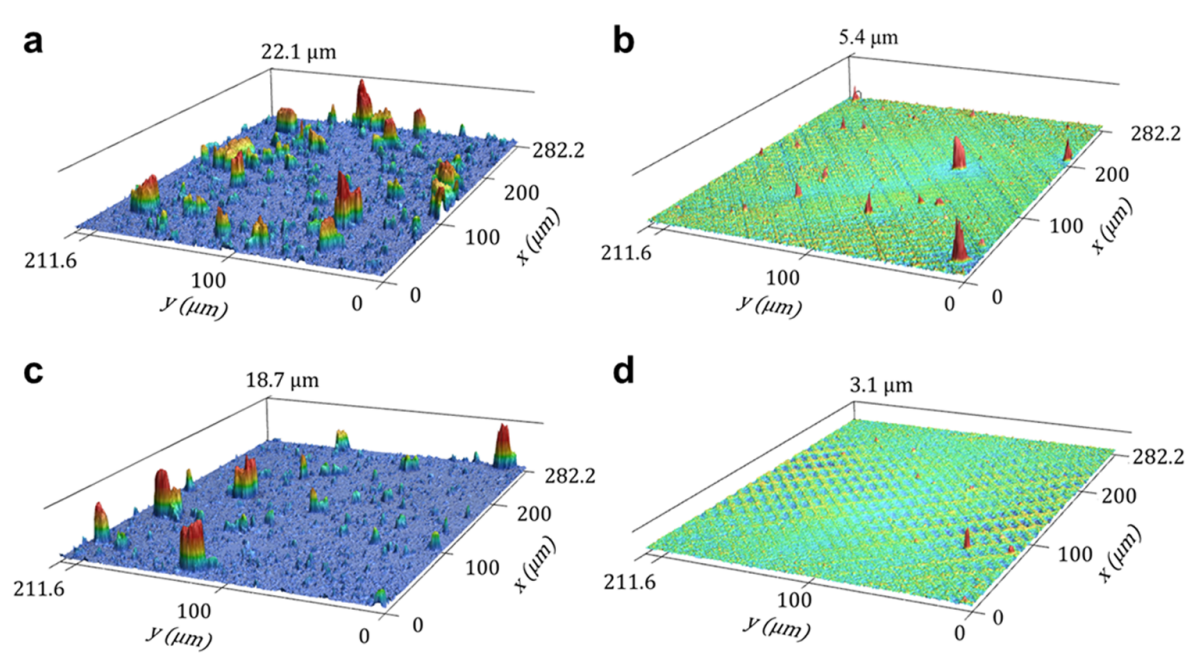
Engineering Large-Area Antidust Surfaces by Harnessing Interparticle Forces

https://doi.org/10.1021/acsami.2c19211 Abstract Dust accumulation is detrimental to optical elements, electronic devices, and mechanical systems and is a significant problem in space missions and renewable energy deployment. In this paper, we report the demonstration of anti-dust nanostructured surfaces that can remove close to 98% of lunar particles solely via gravity. The dust mitigation is driven by…