https://doi.org/10.1116/6.0004977
Abstract
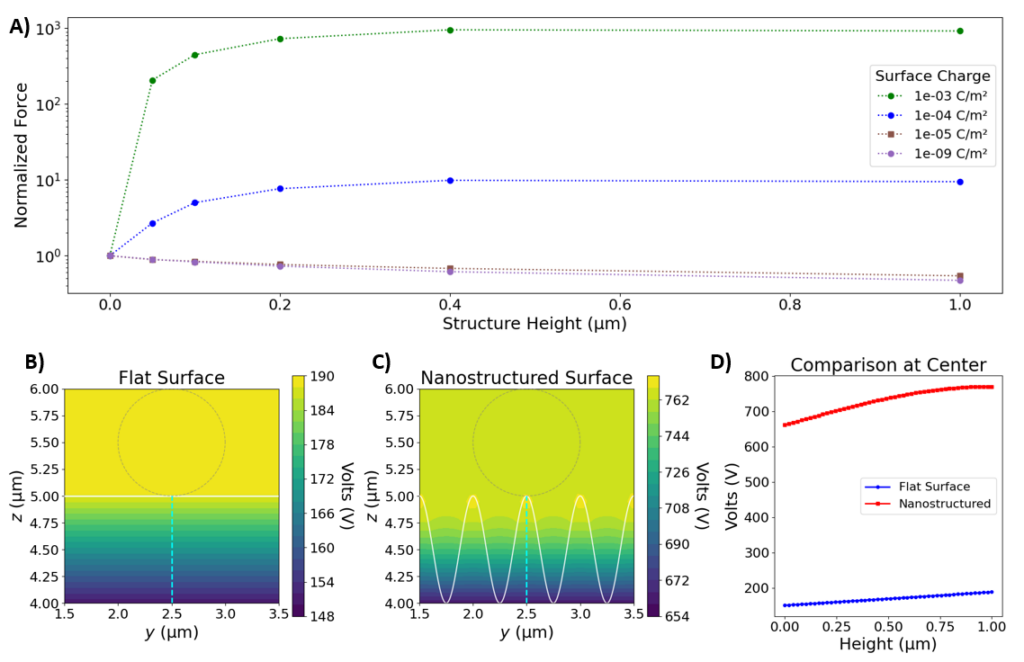
In this work, the effect of nanostructures and surface coatings on the effective electrostatic force acting on a particle resting on the surface is investigated. A proposed analytical model based on Coulomb’s law predicts that electrostatic forces on a particle decrease with the addition of nanostructures due to increased separation distance. Additional comsol simulations were utilized to predict interactions with a highly charged surface relative to the particle, and an inverse interaction is seen. In this case, the added surface geometry leads to an increased electrostatic force on the particle due to greater surface area and charge concentration at structure peaks. Planar and nanostructured polycarbonate surfaces coated with Al2O3, TiO2, Pt, or left bare are contaminated with lunar dust simulant and charged with an electron beam to confirm these predictions. The number of ejected dust particles when a charge is applied is quantified for each of these samples and compared to the initial predictions. The addition of nanostructures on the highly charging polycarbonate substrate led to a doubling of the frequency of particle removal, whereas the low charging Al2O3 and TiO2 samples saw a tenfold decrease in particle removal. By engineering tunable surface responses to electrostatic forces, dust mitigating surfaces will be designed for enhanced performance in charge inducing enviroments, such as the lunar surface.